

Healthcare Is Finally Acting Like a Consumer Industry


News Roundup: What you shouldn’t miss from the last week
With Annalisa Merelli and Meredith Nolan
Subsidies expired, but the House stepped in
The news: Millions of Americans are facing steep increases in health insurance costs as the Affordable Care Act subsidies expired with the new year. But the House drew upon significant Republican backing to resurrect the subsidies, paving the way for a potential compromise on healthcare costs.
The numbers: More than 20 million patients insured through the ACA marketplace will see a premium increase of an average $14%, though in some cases the price tags will go up several times the original premium.
Why it matters: Not only will the financial strain on the insured grow, but the number of uninsured people will go up. The Democrats are expected to make healthcare affordability a central theme in the midterm elections.
Our perspective: Healthcare costs have been increasing year on year, and Americans can’t continue to bear the burden. Something has to give. We’ll continue to pay close attention on whether a consensus decision is reached in the coming weeks.
Everyone is using doctor ChatGPT…
The news: OpenAI says that 200 million ChatGPT users ask AI a medical question once a week, and 40 million do so daily.
What OpenAI said: “For both patients and providers in the US, ChatGPT has become an important ally, helping people navigate the healthcare system,” wrote the company in a report. What’s clear is that consumers - whether we like it or not - are turning to search engines and now increasingly to LLMs for help interpreting medical information.

… so enter ChatGPT Health
The product: OpenAI is introducing a dedicated feature for health questions and searches, designed with collaboration from leading physicians. There is a waitlist to join. In the interim, consumers are continuing to use ChatGpT for advice on health and wellness questions.
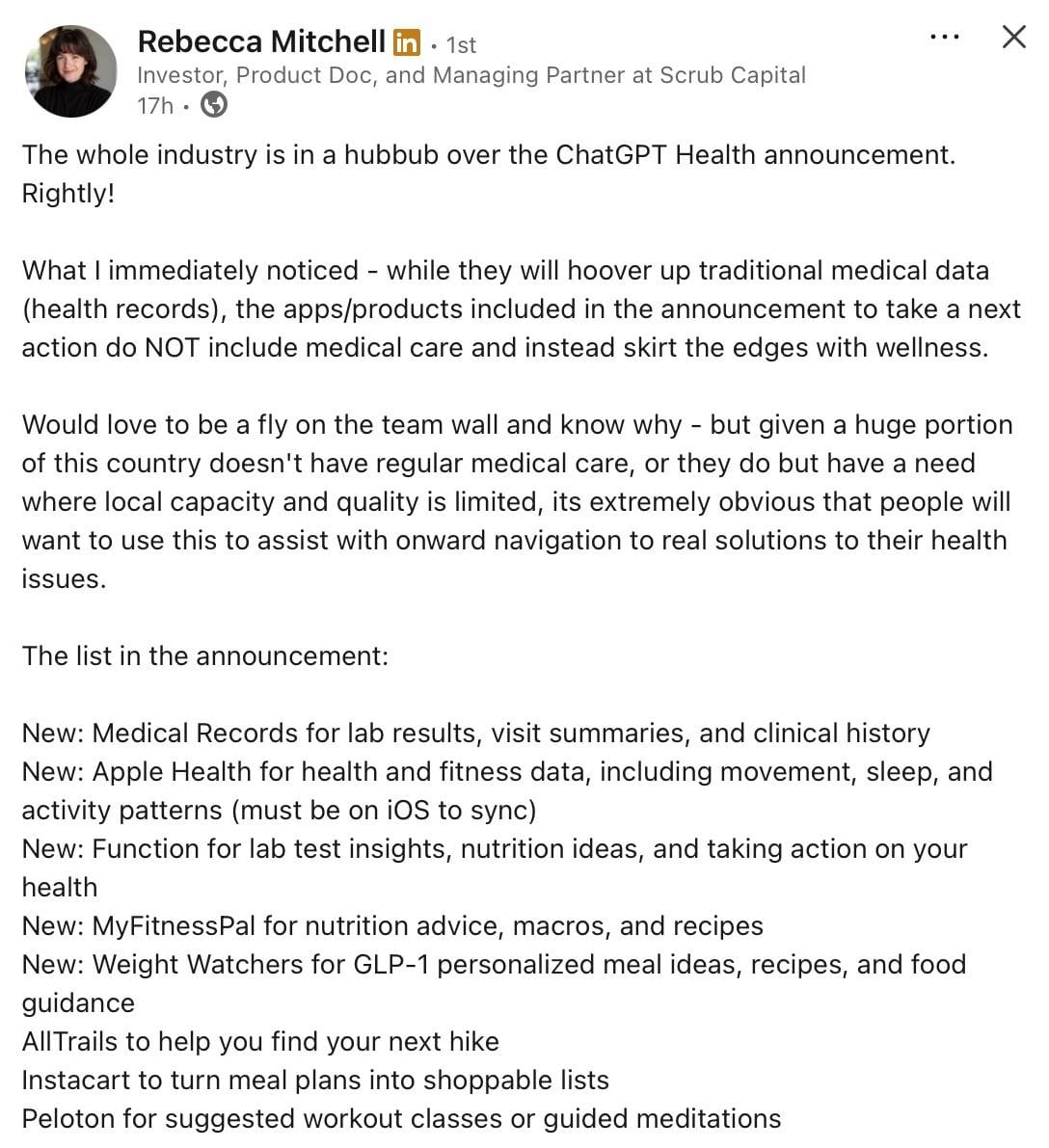
The promise: “You can now securely connect medical records and wellness apps—like Apple Health, Function, and MyFitnessPal—so ChatGPT can help you understand recent test results, prepare for appointments with your doctor, get advice on how to approach your diet and workout routine, or understand the tradeoffs of different insurance options based on your healthcare patterns,” the company shared in a blog post.
What could go wrong? Privacy. Getting patients to understand ChatGPT is not a doctor (see above). Interoperability. And a more subtle, but interesting concern: The partnerships seem to primarily be with wellness companies, versus care delivery. What’s clear is that consumers are looking to ChatGPT to advise them on medical concerns, not just interpretations of their step counts and exercise regimens.
What industry insiders are saying: As a longtime healthcare investor, board member, and operator, Missy Krasner noted on her LinkedIn, OpenAI has pulled off what so many other companies have tried and failed to do: Contextual health search. Krasner was an early team member of Google Health back in the day. She noted that there was massive consumer interest, even dating back to the mid-2000s, but also a lack of trust and privacy concerns. Scrub Capital’s Mitchell notes that the announcement is promising, but that there will be patients that need medical care.
One more thing!
ChatGPT also launched a separate product, ChatGPT for Healthcare. It’s a customized version of ChatGPT designed to be used in a healthcare setting, and is already being rolled out in institutions including Boston Children’s Hospital, Cedars-Sinai, Memorial Sloan Kettering Cancer Center, and Baylor Scott & White Health.
DEA telehealth extension, round four
The news: The DEA issued its fourth extension to the Covid-era exception allowing prescription of controlled substances via telehealth.
The issue: Without the exception, the prescription of these substances would require in-person visits, but the DEA hasn’t settled on a permanent solution, issuing several extensions instead. This latest one runs out at the end of the year.
Why it matters: A flurry of online companies have been popping up since the pandemic and their business model is predicated on being able to prescribe controlled substances (think testosterone, or psychiatric drugs).
Our perspective: This is good news in theory for the industry, but it may be challenging for companies in the space to exit without a permanent decision.
A reminder on upcoming webinars:
Webinar Topic
Timing
Registration
Unpacking the Data on the Telehealth Visits Patients Flocked to This Year
Jan 28, 2026
12 PM ET / 3 PM PT
Anyone can sign up here
Breaking Point: How Soaring Healthcare Costs are Reshaping Employer Strategies
Feb 9, 2026
11 AM ET / 2 PM PT
Subscribers can sign up here
Second Opinion x TytoCare: Unpacking CMS' $50B Investment into Rural Healthcare
Feb 5, 2026
12 PM ET / 3 PM PT
Anyone can sign up here
The FDA will ease the regulations of digital health products
The news: The FDA will no longer require approval for products that deliver single recommendations for doctors.
What the FDA said: “If you’re not making medical or clinical claims, you don’t need to come through the FDA, and we’ll get out of the way,” Commissioner Marty Makary said at the Consumer Electronics Show in Las Vegas.
What experts say: Deciding whether a device is subject to FDA regulation or not is going to be “very blurry,” says Sara Gerke, an associate professor of law at the University of Illinois Urbana-Champaign.
Why it matters: This is in line with the Trump administration’s promise to deregulate AI, and is likely a welcome development in health tech, considering the majority of innovation in health tech is happening through AI-enabled products.
Looking forward
Retiring health CEOs share their parting thoughts on healthcare in 2026 in their exit interviews with Fierce Healthcare. Take a look.
The health AI testing ground: hospitals
Are the investments health systems are making in AI worth it? This Wall Street Journal feature looks at what AI is already doing in hospitals, what it can (and should) do, and what it is not (yet?) equipped to do.
The most wonderful thing we’ve read this week
Bloomberg’s Sarah Frier beautifully written and in-depth profile on Conceivable Life Sciences’ automated lab that could represent the future of IVF. This piece is also deeply personal on many levels. Conceivable’s own lead investor Aike Ho benefited from this technology because it helped bring her own daughter into the world. Cofounder Joshua Abram reminds us throughout about why healthcare entrepreneurship matters. As he told the author, he hoped to someday be known as a part of the team “that made having a child available to millions.” Abram passed away from terminal cancer in August of 2025.
Disclosure: Scrub Capital, the firm where I am a GP, is an investor in Conceivable Life Sciences.
Founding, Deals & Launches
$30 billion for New Mountain Assets: Matt Holt is leaving the firm and is discussing acquiring some of the private equity portfolio for a combined value of $30 billion. We discussed the implications with healthcare industry analyst Stephanie Davis on a recent LinkedIn Live.
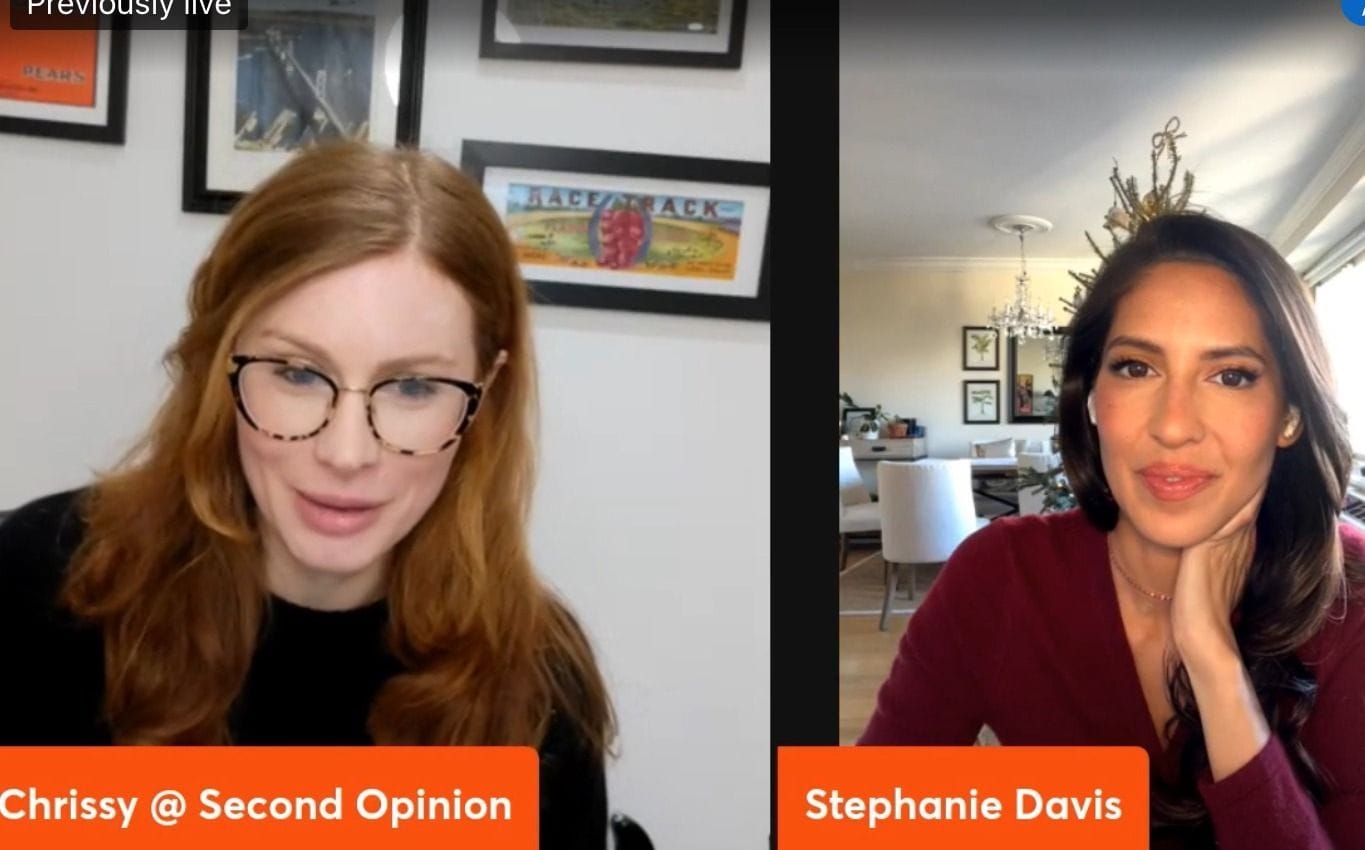
Will we see the first $30B healthtech company? - a webinar with Stephanie Davis and Christina Farr
$92m for Pomelo Care: Women’s health. Medicaid. Services. Not usually a combination that’s working for investors. But Pomelo Care is a standout exception, with a $1.7 billion valuation from Stripes to help it expand its footprint in everything from preconception and fertility care all the way through to support for women going through menopause.
$4.6 million for Oasys: The AI operating system for behavioral health that adds AI insight to therapy, closed a seed round led by Pathlight Ventures.
Equasens acquired 80% of Erevo: In France, the healthcare software & services group acquired a majority of the digital training tool for healthcare providers.
OpenAI partners with b.well Connected Health: The partnership is meant to build the connectivity infrastructure behind ChatGPT Health.
Trascarent adds agentic AI capabilities: The company, which released Wayfinding in 2024 as an AI-enabled care navigator, will add features such as voice AI scheduling and advanced symptom-checking.
Included health launches AI assistant: The virtual care and health navigation company launched Dot, a personalized chatbot and AI-enabled assistant.
Interview with Ratnakar Lavu, Executive Vice President and Chief Digital Information Officer at Elevance Health

1) You previously worked in athletic brand apparel before moving into healthcare. Any lessons learned from the consumer and retail industries that realistically can be applied to healthcare, given compliance, privacy rules, and so on?
My time in consumer and retail taught me the importance of deep personalization and intuitive digital experiences, keeping the consumer at the center of what we do. While healthcare has unique requirements, especially around privacy and compliance, the core principle of being consumer-centric still applies.
At Elevance Health, we’re leveraging digital technologies to create more predictive and personalized healthcare journeys. That means using data and data-driven insights responsibly to anticipate needs, streamlining interactions, and ensuring we’re providing the needed support to those we serve to help simplify the healthcare experience for consumers, care providers, and the other stakeholders we work with.
2) You've been thinking about frameworks for responsible AI. What stands out to you that particularly needs to be addressed in a healthcare setting?
We are committed to using AI responsibly and ethically, with strong safeguards to protect privacy and security. This is non-negotiable. All our AI solutions, whether internally developed or supplier-provided, are governed by policies and procedures to facilitate compliance with regulations governing privacy and data use in our industry.
The AI-powered tools and systems we’ve developed are consistent with our AI Guiding Principles: Accountable, Explainable & Transparent, Fair, Private & Secure, and Robust. It’s also important that AI work aligns with industry standards. At Elevance Health, our approach to responsible AI aligns with the National Institute of Standards and Technology AI Risk Management Framework and guidance from the National Association of Insurance Commissioners.
I also think that AI tools are just that – tools that help us better serve our constituents. These tools help us make care services easier to navigate for consumers, support care providers in delivering higher quality care for their patients, and equip our associates to deliver an enhanced healthcare experience for the people we are privileged to serve.
3) There are mounting concerns in healthcare about insurance using AI and other software programs for denials. How would you address that concern while building these algorithms?
Elevance Health continuously seeks ways to simplify processes, enhance the healthcare experience, and help improve health outcomes for the people we serve. As part of this commitment, for a subset of utilization management (UM) requests, we will be using AI to accelerate approvals. This clinical transformation will help enhance the experiences of patients and care providers and streamline healthcare management, with an aim to drive improved health outcomes.
When developing these types of solutions, a team of clinicians, including medical directors, is embedded in the solution development and testing process. They provide oversight on the use of AI for clinical decision-making.
The AI UM Solution will not automate prior authorization denials. Denial decisions are made by an appropriate clinician through our current process.
4) AI is known to be useful in replacing tasks that are highly manual and repetitive. And yet, there are times when a human desperately wants to engage with another human. To that end, what is the right way to use it when it comes to the call center?
That’s a great question and one we constantly refer back to when developing new tools and systems.
When consumers call us, they are often managing a stressful health moment and want to speak to another human. That’s when human empathy matters most. AI should handle the routine tasks, so our people can focus on providing the support and compassion needed to help our members navigate their healthcare needs. Our priority is to keep the consumer at the center of what we do.
For example, our member services team currently uses AI to streamline workflows, surface relevant information needed to support members, and reduce wait times—but more importantly, we’re investing in those tools to free up our associates to spend more time with members. It’s very similar to many AI-powered point-of-care tools. They are there to augment the administrative work for the clinician, like research or note-taking, while giving them more time back to really listen and care for their patients.
“Lifers” Podcast Takeaways — Warris Bokhari, CEO & Co-founder, Claimable, Inc.
In an unscripted, freewheeling, fast-thinking episode, co-hosts Mike Desjadon, CEO of Anomaly, and Christina Farr talk to Warris Bokhari, CEO & Co-founder of Claimable, to look at “an enormously regulated space, a super complex eco-system to crack.”
Claimable is taking on the hard job of building a direct-to-consumer business in healthcare payments, which includes handling denials of desperately needed care. Anomaly is also focusing on the denials problem, exposing payer behavior through data.
There may be 850 million denials per year, according to Claimable (Spoiler alert: Nobody knows the real number because the insurers aren’t sharing the data.) In this episode, you’ll hear real stories of healthcare denials, too.

How money really flows in healthcare with Claimable CEO Warris Bokhari & Anomaly CEO Mike Desjadon
Takeaways
No question about it—costs are crazy, the system is unfair, the payment model needs to evolve. So how can money actually flow judiciously in healthcare?
What about AI? One suggestion about dealing with LLM, AI, and robotic responses is to look at denials as a game: The best way to win is to not play.
People are busy just living their lives. They’re working, feeding, and running a household, raising children, and being a carer. They don’t have time to deal with healthcare complexities. But can AI do the job?
Get it done. Healthcare needs more challenges to corporate and the current payment model. Can backing by venture capital have a positive impact by investing in the right places? (Or, would this already have happened if it was going to be successful?)
Tune into the full episode on YouTube, Spotify, or wherever you get your podcasts.
Upcoming Sessions
Live conversations with the people shaping healthcare.

Verifying AI in Medicine: Is Healthcare AI Actually Ready for Deployment?
Is AI ready for real-world clinical care? Dr. Zak Kohane and Protege’s Engy Ziedan debate what it takes to safely trust AI in diagnosis and treatment, from benchmark performance and clinical evidence to whether we’re holding AI to a higher standard than humans.

Why Are Hospitals Hiring Chief AI Officers?
As AI moves from pilots into day-to-day healthcare operations, health systems are having to decide who should actually own the


Where are AI Agents Actually Working in Healthcare, and Why?
While the healthcare industry remains locked in a high-level debate over the theoretical potential of artificial intelligence, a select group of

Top Employers Share What Healthcare Startups Need to Know in 2026
As enterprise health purchasers face volatile medical cost trends and tightening operational margins, the standard vendor pitch of "improved clinical efficiency&

Peptide Therapy: Where Do We Go From Here?
Watch the full webinar Peptide therapies have moved from niche biohacking circles into mainstream medicine, reshaping conversations around weight management, metabolic health,

Not everyone can access the top 1% of physicians. Will AI change that?
Historically, top-tier medical expertise was limited by wealth and geography. As AI reshapes healthcare delivery, a vital question emerges: can it democratize intelligence to give everyone access to the caliber of care typically reserved for the top 1%?

Privacy AI and the Future of HIPAA
Watch the Full Webinar As AI reshapes healthcare and more patient data flows beyond traditional clinical settings, the rules governing privacy, access,

What will AI do for employer healthcare and benefits?
Employer healthcare may be one of the most practical — and overlooked — proving grounds for AI.

Hospitals as the new go-to-market, lessons from the trenches
Watch the Full Webinar Health systems are entering a new frontier, one where innovation isn’t optional, and meaningful change requires creativity,