

Healthcare in 2026: What Comes Next for AI, Employers, GLP-1s, and Digital Health


Happy holidays, everyone! It is a busy period for most of us as we’re racing towards the finish line for the year and contemplating what’s next. It’s also the season of healthcare predictions run amok. I have seen so many pieces, tweets and blog posts espousing what’s ahead for 2026 - with a standout set as usual from the venture firm Venrock.
But I figured I’d mull over and share some of my own, particularly after talking with so many peers on what they expect to see. So this list is primarily mine and these opinions are my own, but I’ve certainly been influenced by the policy thinkers, entrepreneurs and investors that I talk to regularly.
Some of these predictions may not pan out. But I promise to hold myself accountable and will check back at the end of next year to see how I did.
Health plan M&A? Perhaps not. Health plan transactions may make sense in theory, but will struggle to get through the Trump administration. That is clearly not ideal for digital health, and will stymie exits for the category.
A few more IPOs, but not a lot: There will be a few more IPOs in health tech, but a trickle, not a flood. The companies that are most watched and have the highest potential to go out next year - again, in my opinion - include Aledade, Zelis, Innovacer, and Included Health. But my expectation is it’ll be no more than a few names.
The first autonomous doctor starts administering care – but despite the headlines that we’ll see popping up around how the future is here, the scope will remain highly limited (both on a state-by-state basis and what the AI can actually do to treat patients). Linked to that, we’ll see more state sandboxes for testing out new AI tools for care delivery, like this one in Utah. That will be critical for innovation, because the alternative is the highly complex and slow FDA clearance route.
The largest digital health companies will all flock to the ACCESS program to find a new business model in Medicare, while also duking it out for a slice of the available rural health funding. Much of that is already in motion. There’s no question digital health companies will be the beneficiaries, particularly given that the executive and policymaker running Medicare - Chris Klomp - has an entrepreneurial background and formerly sat on the board of venture-backed Maven Clinic.
It’ll be a strong growth year for direct-to-consumer, wellness plays for a variety of reasons including the tailwinds from MAHA (the ELEVATE model is a good example), and the rise of level funded plans amongst smaller firms in particular. Investors that remained aligned with enterprise-only plays may start kicking themselves.
A few more jumbo employers will embrace transparent PBMs, like CapitalRx (now JudiHealth), and we’ll continue to see the rise of “carve-out” programs related to high-cost specialty drugs, inclusive of the GLP-1s. Employers will increasingly look for ways to subsidize access for their members to cheaper, cash pay prices.
Cell and gene therapies will become an even bigger topic in the media and amongst patient advocacy groups, particularly given the problem of cost. These treatments can be highly effective, even curative, but cost millions of dollars. Employers will sit up and take notice, after getting hit with their first multi-million dollar claims. We’ll spend a lot of 2026 talking about potential ways to reimburse for these drugs. Some employers will decline to pay for these treatments altogether, a select few will approve access to these treatments for those who qualify or even seek members out to let them know about the option, and the largest cohort will find a potential middle ground. It all comes down to whether the employer is operating a high-margin business, how well paid the employees are, and whether there’s tenure. The PR blowback will be major here given that many of these treatments are most beneficial for dependents (namely kids).
GLP-1s will continue to come down in price, as employers will grapple with how to cover them for their members. As that occurs, there will be more promising indications, inclusive of potential use for addiction therapies. In general, indications will expand for these drugs, and enthusiasm will remain high. The big question, though: Will companies in digital health continue to prescribe compounded versions without consequence?
AI will move from more diagnostic applications to therapeutic ones (hat tip to Manatt’s Jared Augenstein for this classification). Where we see AI tools today is mostly in the arena of diagnosis - imaging, risk prediction, screening and so on. Where we’ll see all this go is in solutions to treat disease, like mental health chatbots, lifestyle coaches, surgical and robotic AI, and so on.
Healthcare will only get more expensive. There’s absolutely no question this will happen. Premiums will continue to rise, employers will face yet another record-setting year for healthcare costs, and patients will increasingly foot the bill. Without true competition in the market, there’s no incentive to reduce healthcare costs.
On a personal note, I’m gearing up for a big year for this newsletter and I’ll keep you apprised in the coming weeks with updates. As we move into the holidays, I’ll share how endlessly grateful I am to all of you for reading us this year, and in continuing to support us. Those of you who partnered with us, subscribed, shared, and contributed - just thank you.
With that, I hope you enjoy this “four questions with” interview with Included Health’s Owen Tripp, followed by a roundup of key news and deals via our contributor Annalisa Merelli.
Four questions with Owen Tripp, CEO of Included Health

1. Any immediate reactions to the new CMS ACCESS model? Recognize we still don't have all the details quite yet, but any takeaways that you've been able to glean so far?
I’m genuinely excited about it. The new ACCESS model is a real move toward more outcomes-oriented payment options, and it shows that CMMI is thinking about the types of metrics and clinical indicators that actually demonstrate people are progressing toward better health.
What’s great is that these outcomes matter a lot to the Medicare population -- which is where most of the attention is right now -- but strong digital health companies will find them totally complementary and applicable across every market. Whether your business serves commercial, individual, Medicare, or Medicaid populations, building workflows toward these clinical metrics and being able to report on them is going to help move your company and the broader healthcare system forward.
The part I’m most excited about is that eligible members can enroll directly. That appears to be a first for CMMI, and it really opens the door for member-first organizations like ours. Direct access removes the traditional barriers to care, and enables us to engage members in their health journey earlier and more proactively, potentially driving better outcomes in the long run.
2. Everyone is talking about AI being transformational, but no one is sharing detail. Can you share something that has operationally changed about the business because of AI?
The talk has massively outpaced the actual use cases in AI overall, but I’m still optimistic. I believe we’re in a spot where AI will become much more member-facing in obvious, easy-to-use ways very soon.
There are two very tangible use cases for us at Included Health. First, we’re using AI internally with our teams to streamline their work. Over 70% of our clinicians have adopted our AI Scribe for notes, and across the company we’re using our own AI models to drastically reduce turnaround on employee service tickets. AI is integrated directly into our communication channels so employees can get quick answers on things like time off, company policies, system access, and reporting processes, and during open enrollment our AI assistant was able to support our own employees with their questions in the same personalized way we’re able to support our clients and their members. These were tasks that previously required a lot of time that AI can now support.
Second, we’ve been using AI to ensure our members get their questions answered, fast. Sometimes those are benefits or coverage questions that can be answered by our AI assistant Dot, which has been supporting members for over a year now with over 95% accuracy. Other times, those questions need to be answered by a clinician or care team member who is being supported behind-the-scenes with a really robust AI-powered search tool that enables our team to answer member questions quickly and thoroughly.
3. Would you have raised capital differently if you had been able to start Included today, versus more than a decade ago before we had AI to make so many business processes more efficient?
Honestly, no -- I probably would have raised even more. It’s true that businesses can operate more efficiently today because of AI, and that’s worth celebrating. But I still firmly believe that raising meaningful, signal-setting rounds allows you to take on capital, make smart bets, and take risks on growing quickly, no matter the environment. With AI, we may be resetting on what it takes to grow now, but there will always be other areas where having a deep capital base lets you compete in a differentiated way.
4. What's one super tactical piece of advice you'd give to a founder trying to sell into the employer channel today?
If I were talking to a founder selling into employers, I’d tell them to walk into every meeting with one goal: to learn as much as you can about what’s keeping that person up at night. It could be pressure from their boss, budget constraints, or the swirl of priorities on their team -- or it could be none of that. Founders often think the conversation is about their product, or some specific technical comparison that the buyer really cares about. In my experience, that’s rarely what people are focused on. They care about whether you understand their reality, and if you can help them solve the problems that matter most to them.
Upcoming webinars:
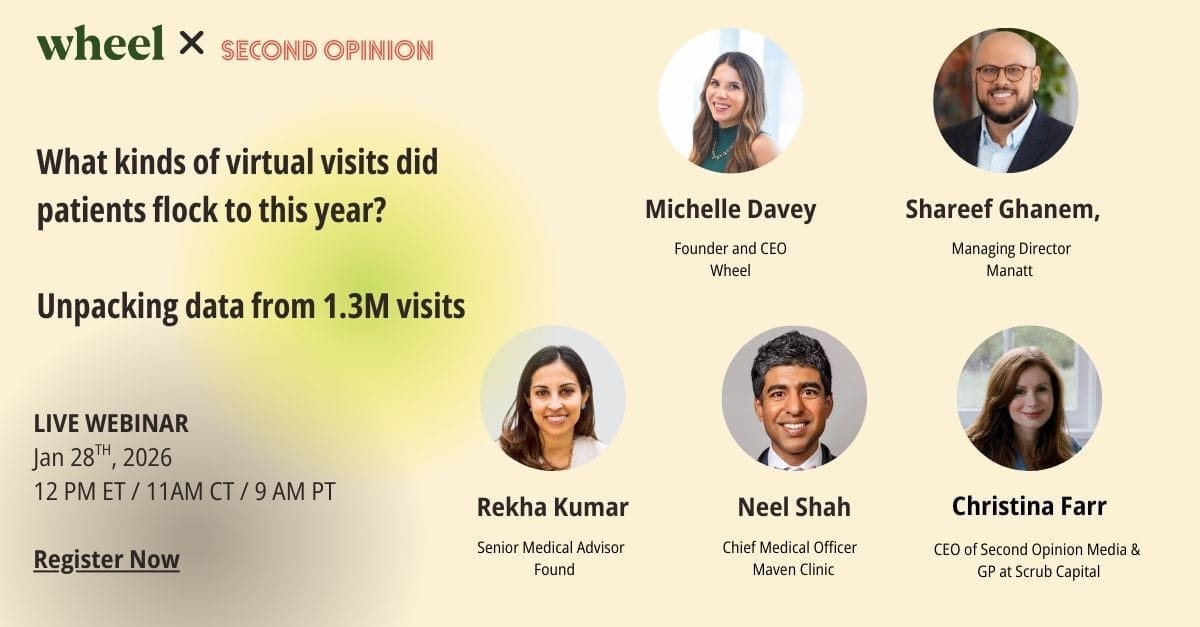
What kinds of virtual visits did patients flock to this year? Was it women’s health, primary care, urgent care, behavioral health?
We unpack data from 1.3M visits (thanks Wheel!)
Jan 28th 2026
12PM ET/ 11 AM CT/ 9AM PT
Anyone can sign up here
Breaking Point: How Soaring Healthcare Costs are Reshaping Employer Strategies
Feb 9, 2026
11AM ET
Anyone can sign up here
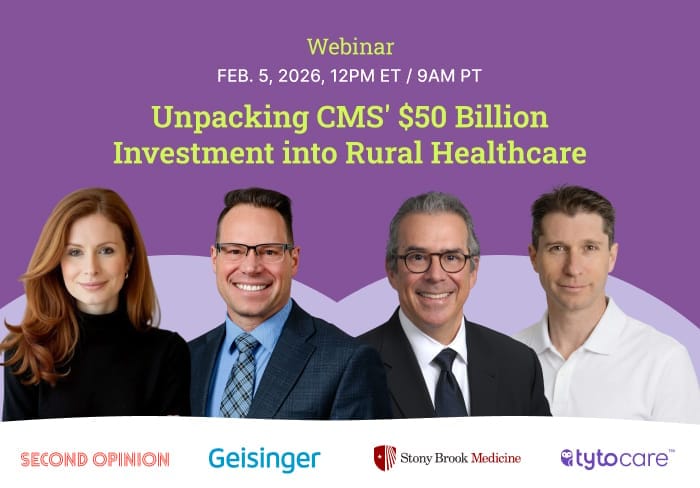
Live Second Opinion Media, Geisinger, Stony Brook & TytoCare Webinar: Unpacking CMS' $50 Billion Investment into Rural Healthcare
Feb 5, 2026
Anyone can sign up here
News Roundup: What you shouldn’t miss from the last week
With Annalisa Merelli
HHS cuts funding to pediatrics
The news: HHS is cutting funding to for seven grants to the American Academy of Pediatrics after an escalating dispute related to vaccines.
What’s in: The grants supported initiatives in areas like reducing sudden infant deaths, improving teen health, and identifying autism early, an academy spokesperson told the media.
What HHS said: HHS said the grants were cancelled, alongside other programs, because they “no longer align with the Department’s mission or priorities.”
Why it matters: Pediatric healthcare is already significantly underfunded compared to adult medicine. And pediatric providers make far less, disincentivizing the flow of talent into pediatrics and hospitals from offering comprehensive pediatric care, especially in rural areas. Medicaid covers nearly half of all U.S. children.
PwC expects healthcare M&A to bounce back in 2026
The news: A new report from the consulting firm says after cooling down in the last months of 2025, health deals are expected to pick up next year.
What’s in: Private equity investments in AI, telehealth, workforce optimization and revenue management tools.
What PwC said: “While an uncertain U.S. regulatory and reimbursement environment remains the primary headwind, investors will benefit in 2026 from assets coming to market in high-quality, cash-generating subsectors with clear reimbursement visibility," the analysts said.
Why it matters: As with all things, the answer here is “it depends.” I agree that there will be M&A in healthcare, but there’s still concerns around antitrust that are very real. That said, there will be more profitable assets to buy with solid unit economics as more companies have shifted away from a “growth at all costs” mindset.
The amendment to extend Obamacare subsidies is stuck
The news: After progress on an agreement to allow a vote for the extension of Affordable Care Act subsidies, the amendment is stuck.
What happens: If it doesn’t pass, health insurance costs will spike for millions of people, and moderate Republicans are worried about the midterm impact.
How much is it? Extending the subsidies costs about $35 billion a year.
Why it matters: We wouldn’t be surprised by another shutdown in January. Get ready.
Some hospitals mark up cancer drugs by hundreds of times
The news: A Bloomberg investigation found that the price for oxaliplatin, a two-decade-old generic chemotherapy drug, can vary significantly depending on how much a hospital decides to mark it up.
Name your price: The same infusion can be $35. Or $134. Or $13,560. One insurance plan was charged $90,000 for a series of infusions — or 700 times what Medicare pays.
Villains everywhere: Insurance companies often take the heat (and with reason) when it comes to treatment access and cost. But this story shows there are many bad-faith actors exploiting the system (which is, in fairness, pretty easy to exploit for profit).
Why it matters: Pharma will price drugs at what the market will bear. And that’s the system we have.
Your thoughts?
Triple Ring Technologies is a “corporate growth lab” that helps companies bring new concepts to market, handle government contracts, and start new ventures. Recently, the group spearheaded some international innovation summits — brokering collaboration between US companies and Japanese, Korean, and Polish ones — and is framing the effort as an example of Innovation Diplomacy. It could be mere marketing, but it could also be a new and interesting approach which could gain more weight in light of the increasing limits of actual diplomacy and international trade. Your POV?
Launches & Research
Thatch is partnering with ADP: The employer-focused health benefits platform is going to embed its Individual Coverage Health Reimbursement Arrangement (ICHRA) into the HR and payroll platform. ADP is an investor in Thatch, and contributed to its $40 million Series B round in April.
An AI-enabled exoskeleton: Researchers from the University of Queensland in Australia have prototyped a lightweight human exoskeleton aimed at helping people with neuromotor diseases (such as ALS) continue moving, and are currently testing a second version, equipped with AI capabilities to personalize assistance.
Funding & Deals
A $300 million state investment: New York State’s governor Kathy Hochul announced the investment, which is aimed at modernizing hospital IT, boosting telehealth capabilities, and strengthening cybersecurity.
$37 million for Axion: Salesforce Ventures led the series B for the AI-enabled, manufacturing quality control company.
$65 million for Artera: The company building out AI agents for patient communication, raised a growth investment from lead investor Lead Edge Capital and others.
Paradigm raises $78 million: The clinical research business closed a Series B led by ARCH Venture Partners and announced the acquisition of Flatiron's Clinical Research business. The two companies will integrate their platforms.
$134 million for Angle Health: The AI-native health benefits platform closed a Series B led by Portage.
Reema Health raised $19 million: The care navigation platform for complex patients closed a series B led by LRVHealth and Optum Ventures.
$11 million for Lin Health: The digital behavioral health platform for chronic pain patients, secured $11 million in its Series A led by Proofpoint Capital.
$30 million for Valerie Health: The “AI front offices” for physicians closed a Series A funding led by Redpoint Ventures, bringing the company’s total raised capital to $39 million.
$50 million for Nanit: The AI-enabled early childhood tech company raised funds from Springcoast Partners and others to expand its AI insight into sleep patterns and other developmental areas.
$14 million for WearLinq: The wireless remote heart monitoring company closed a Series A led by AIX Ventures. It also raised $5 million in venture debt funding.
Drive Health gets $15 million: Vitalis Ventures made an investment in the Google-powered AI platform designed to help patients navigate care and alleviate the workload placed on clinicians.
Adaptive signs an $890 million deal with Pfizer: The immune system sequencing company signed two non-exclusive deals with the pharma giant to analyze immune cells from rheumatoid arthritis patients and share Adaptive's large internal database that links T-cell receptors with the substances they recognize.
Hims & Hers Health acquires YourBio Health: The telehealth platform finalized the purchasing agreement with the Boston-based pioneer in capillary whole blood sampling technology. The terms of the deal have not been disclosed.
Upcoming Sessions
Live conversations with the people shaping healthcare.

Is It Finally the Moment for Alternative Plan Design?
Employers are under growing pressure to control healthcare costs while improving access, outcomes, and the member experience. That has renewed interest in

Type 2 Diabetes & Cardiometabolic Care: Wearables, AI & GLP-1s
The rise of wearables, GLP-1s, and AI is reshaping treatment for Type 2 diabetes, weight loss, and metabolic disease. We have

Verifying AI in Medicine: Is Healthcare AI Actually Ready for Deployment?
Is AI ready for real-world clinical care? Dr. Zak Kohane and Protege’s Engy Ziedan debate what it takes to safely trust AI in diagnosis and treatment, from benchmark performance and clinical evidence to whether we’re holding AI to a higher standard than humans.

Why Are Hospitals Hiring Chief AI Officers?
As AI moves from pilots into day-to-day healthcare operations, health systems are having to decide who should actually own the


Where are AI Agents Actually Working in Healthcare, and Why?
While the healthcare industry remains locked in a high-level debate over the theoretical potential of artificial intelligence, a select group of

Top Employers Share What Healthcare Startups Need to Know in 2026
As enterprise health purchasers face volatile medical cost trends and tightening operational margins, the standard vendor pitch of "improved clinical efficiency&

Peptide Therapy: Where Do We Go From Here?
Watch the full webinar Peptide therapies have moved from niche biohacking circles into mainstream medicine, reshaping conversations around weight management, metabolic health,

Not everyone can access the top 1% of physicians. Will AI change that?
Historically, top-tier medical expertise was limited by wealth and geography. As AI reshapes healthcare delivery, a vital question emerges: can it democratize intelligence to give everyone access to the caliber of care typically reserved for the top 1%?

Privacy AI and the Future of HIPAA
Watch the Full Webinar As AI reshapes healthcare and more patient data flows beyond traditional clinical settings, the rules governing privacy, access,