

This white paper shows how insane the U.S. healthcare system is

Commercial negotiated rates vary wildly, but they don’t correlate with quality.
If you work in benefits, health plan design, or employer strategy, this new white paper from the Purchaser Business Group on Health (PBGH) is required reading. It pulls back the curtain on healthcare price transparency in the commercial market, revealing just how erratic and random U.S. healthcare price variation really is.
Unlike previous regional studies, this analysis spans multiple geographies and specialties, marrying transparency in coverage and hospital price transparency data with claims, quality, and safety measurements. The result: a disturbing portrait of how commercial negotiated rates are essentially arbitrary. What’s worse, the rates have little connection to clinical performance.
The study at a glance
- Conducted through the Health Care Data Demonstration Project, the research draws on five major employers (think Boeing, Qualcomm, and the City/County of Denver).
- It syncs provider pricing, claims data, and quality/safety metrics across regions.
- The stated goal: empower self-insured employers to spot opportunities for employer healthcare cost savings by holding vendors accountable.
As Elizabeth Mitchell, CEO of PBGH, puts it, “It is transformative because it enables employers to fulfill their fiduciary duties, hold vendors accountable, and drive down costs for their workforce.”
What I found most jarring
(Full disclaimer: I’ve only done a skim, versus a deep dive, on the evidence backing up the analysis. I welcome debate on methodology.)
1. Commercial negotiated rates are all over the map
Medicare uses structured adjustments (e.g. wage indexes) to reflect regional cost differences. But in the commercial world? It’s chaos. The paper notes, “commercial negotiated rates vary arbitrarily and drastically.” One striking example: a Cesarean section without complications cost $11,547 in Chicago but $27,199 in Northern California. This gap goes far beyond plausible differences in labor or facility costs.
2. Transparency is still mostly an illusion
Even today, many providers don’t share real dollar amounts. Instead, purchasers see “average regional discounts off billed charges.” Hardly transparent. The authors argue that true commercial price transparency would allow purchasers (employers, health plans) to negotiate more aggressively and push down prices.
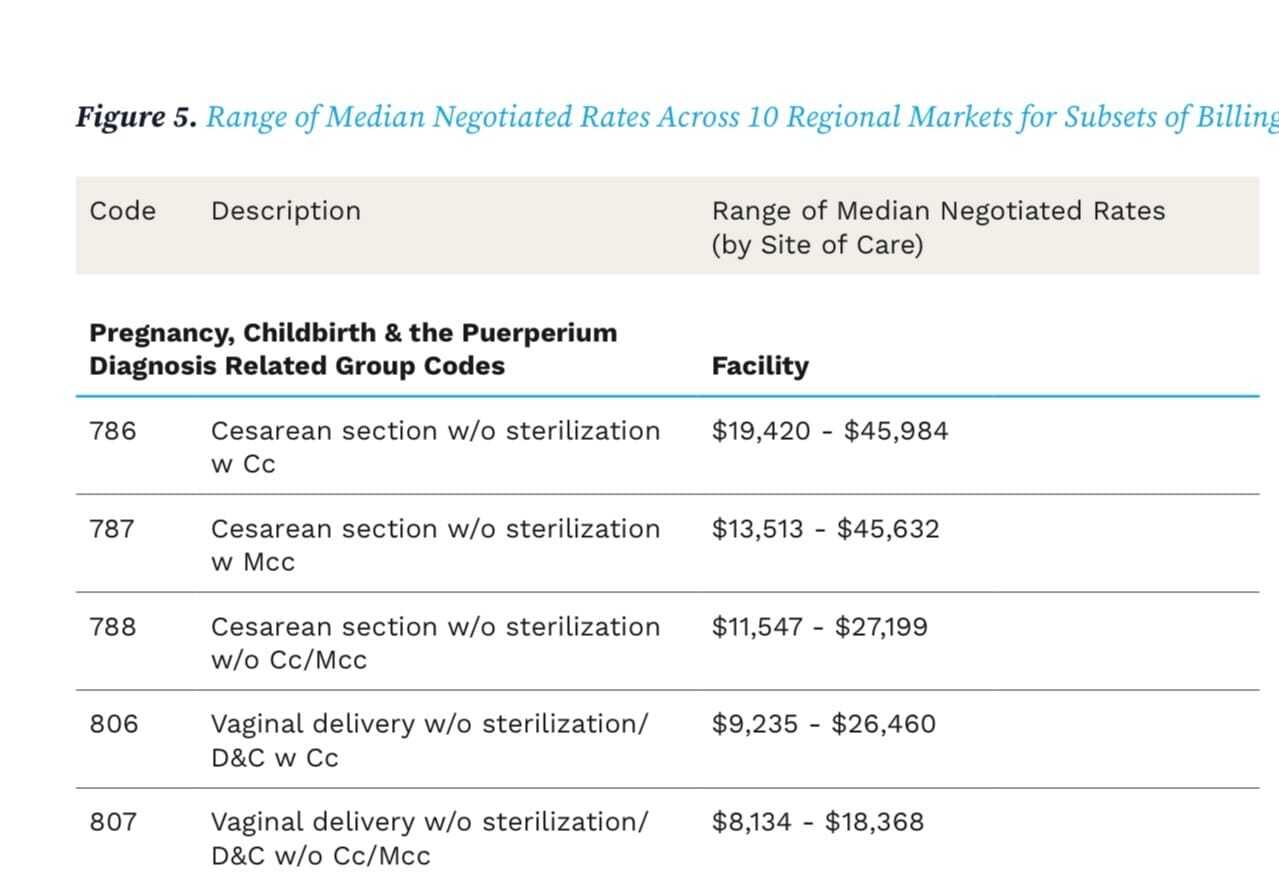
3. No rhyme or reason by service line or region
Northern California is expensive for maternity services; Oregon is a hot spot for orthopedics...there’s no consistent pattern. That lack of logic undermines any attempt to benchmark or standardize pricing.
4. Price ≠ quality
Perhaps unsurprising (but deeply concerning) the analysis, citing Embold Health, demonstrates minimal correlation between higher costs and better outcomes. In fact, some lower-priced providers outperform on standardized clinical measures.
5. What’s actually driving higher prices
The paper points to provider market power, brand loyalty, and positioning, not superior clinical outcomes. In short: reputation and negotiation leverage often matter more than results.
The human cost
As healthcare prices soar, more cost burden gets shifted to the patient, and surprise medical billing (aka balance billing) continues in many places, despite legal bans. The stress on patients and employees is immense. We already know people skip care or avoid needed treatment to avoid debt.
This system cannot be “fixed” by tweaks. We need structural re-alignment: policies, enforcement, accountability. And in the meantime, employers and benefits leaders must be informed, strategic, and bringing the right partners around the table.
What should employers do now?
If you’re an employer or benefits leader reading this, the authors of the paper urge:
- Demand accessible, real negotiated rate data (beyond discounts).
- Use Transparency in Coverage and hospital price transparency files to build internal analytics.
- Benchmark aggressively, even geographically.
- Tie vendor accountability to both cost and clinical quality.
- Educate employees on out-of-network risk and balance billing exposure.
- Support policy reforms that mandate true price transparency and curb unchecked healthcare price variation.
Final thoughts
This white paper is yet another wake up call, as cost surges year after year impact all of us. As we wrote this week, it can’t continue to be absorbed forever. The U.S. healthcare commercial market is operating in the dark, where commercial negotiated rates can vary tenfold or more, and pricing bears little relation to outcomes.
As we head into conference season, let’s stay grounded in the data, and push for solutions, not just rhetoric. See you at HLTH in Las Vegas next week.
Upcoming Sessions
Live conversations with the people shaping healthcare.

Verifying AI in Medicine: Is Healthcare AI Actually Ready for Deployment?
Is AI ready for real-world clinical care? Dr. Zak Kohane and Protege’s Engy Ziedan debate what it takes to safely trust AI in diagnosis and treatment, from benchmark performance and clinical evidence to whether we’re holding AI to a higher standard than humans.

Why Are Hospitals Hiring Chief AI Officers?
As AI moves from pilots into day-to-day healthcare operations, health systems are having to decide who should actually own the


Where are AI Agents Actually Working in Healthcare, and Why?
While the healthcare industry remains locked in a high-level debate over the theoretical potential of artificial intelligence, a select group of

Top Employers Share What Healthcare Startups Need to Know in 2026
As enterprise health purchasers face volatile medical cost trends and tightening operational margins, the standard vendor pitch of "improved clinical efficiency&

Peptide Therapy: Where Do We Go From Here?
Watch the full webinar Peptide therapies have moved from niche biohacking circles into mainstream medicine, reshaping conversations around weight management, metabolic health,

Not everyone can access the top 1% of physicians. Will AI change that?
Historically, top-tier medical expertise was limited by wealth and geography. As AI reshapes healthcare delivery, a vital question emerges: can it democratize intelligence to give everyone access to the caliber of care typically reserved for the top 1%?

Privacy AI and the Future of HIPAA
Watch the Full Webinar As AI reshapes healthcare and more patient data flows beyond traditional clinical settings, the rules governing privacy, access,

What will AI do for employer healthcare and benefits?
Employer healthcare may be one of the most practical — and overlooked — proving grounds for AI.

Hospitals as the new go-to-market, lessons from the trenches
Watch the Full Webinar Health systems are entering a new frontier, one where innovation isn’t optional, and meaningful change requires creativity,