

Lifers hits 1M views and Midjourney enters medical

Ruth, here. It’s been a busy week here at Second Opinion. This week, we’re celebrating over one million views and downloads of the Second Opinions podcast Lifers. One thing we’ve learned? Healthcare leaders are hungry for thoughtful, in-depth conversations about the ideas, technologies, and people shaping the future of healthcare. You can read more about this milestone here.
This week I spoke with Ryan Howells, author of "Kill the Clipboard” and a principal at Leavitt Partners, andLisa Bari, Innovaccer's head of policy and partnerships, about health data access. We had a spicy conversation about the challenges of interoperability and whether enforcement on data blocking is in fact coming as promised. You can watch that conversation here.
I also pieced together a possible future for AI in primary care, based on my conversations with both health system and digital health company leaders. While no one can predict the future, I looked at how fee-for-service medicine incentivizes the use of AI in primary care and how that technology could be used to refer more care to specialists. With the existing downward pressure on primary care physicians—lower pay, unfavorable reimbursement, market consolidation— primary care is at risk of disappearing. How we avoid this future, according to providers and policy experts, is a matter of figuring out how to pay for primary care in a sustainable way. You can read the piece here.
I will say, we’ve already gotten some great feedback on this piece and I encourage you to reach out with your thoughts on it.
If you’re looking for more on the topic of AI replacing or supporting primary care, two relevant papers came out in Nature this week. One examines the ability of agentic LLMs to manage chronic disease and the other studies their ability to autonomously manage patient cases inside of the electronic health record.
Now, onto the news.
Exciting news! Rounds: Where Healthcare Meets Wall Street is here.
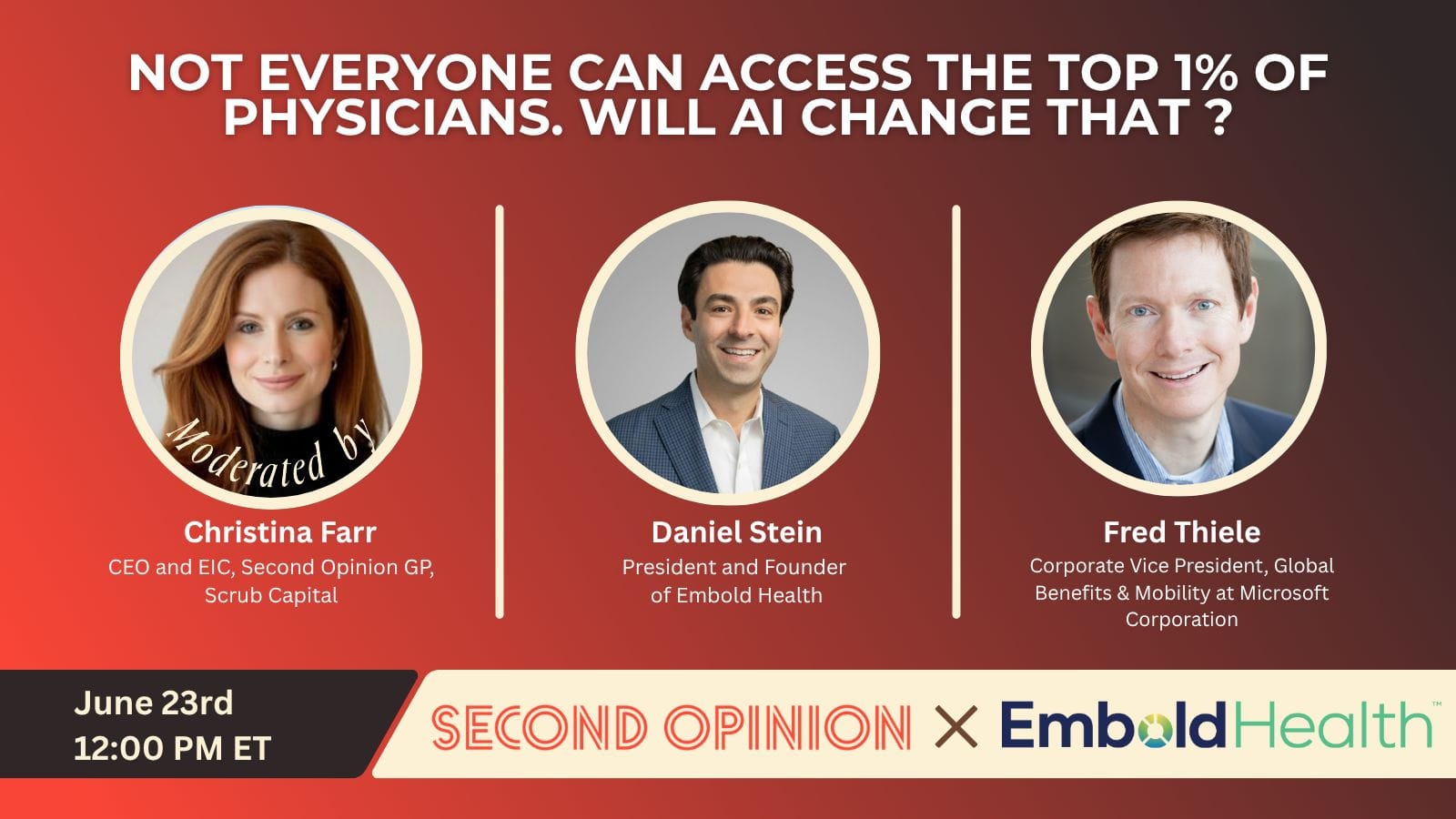
Hosted by Christina Farr and Stephanie Davis, this new six-episode live series explores the intersection of healthcare innovation and financial markets — with a new guest every episode, proudly sponsored by SVB.
The first episode drops Thursday, June 25th at 1 pm ET and is available on Spotify, Apple Podcasts, YouTube, X, and LinkedIn.

Reserve Your Spot for Upcoming Webinars!
NEWS
- AI imaging company Midjourney announced Midjourney Medical and its foray into a nearly full-body ultrasound. Christina Farr gives her take on the announcement here.
- Cedar, a patient financial platform for healthcare providers, announced that its AI voice agent Kora has handled nearly 400,000 patient calls nationwide since its April 2025 launch. At Gastro Health, one of the largest U.S. gastroenterology practices, Kora has handled more than 60,000 calls, driving a 24% decrease in live agent handle time and a 22% decrease in call center staffing.
- Centene will offer buyouts to employees following steep losses in its health plan membership, driven by weakening Obamacare enrollment after pandemic-era subsidies expired. Most of Centene's 61,000 employees will be eligible to apply for the voluntary separation program.
DEALS
- Everlab, an Australian healthtech focused on preventative healthcare, raised AU$65M in an oversubscribed Series A led by Airtree Ventures. Participants included global investor Plural, existing investors Left Lane Capital and b2venture, and angel investors including Australian Test captain Pat Cummins.
- Mavida Health, a virtual provider of mental health services for women and mothers, is being acquired by Wisconsin-based WPS Health Solutions, a benefits administrator and nonprofit health insurer; financial terms were not disclosed. Mavida will continue operating independently, retaining its leadership team, with WPS Chief Growth Officer Rochelle Myers also serving as Mavida's new president.
- Clair raises $11.6M in funding for its hormone tracking wearable device.
InStride Health, a provider of specialty mental healthcare to children, teens, and young adults, landed $30M in Series C funding to expand to new markets and broaden its payer network. Echo Health Ventures and FMZ Ventures led the round as new strategic investors, with existing investors Valtruis, 406 Ventures, General Catalyst, and Mass General Brigham Ventures also participating.
Opportunity of the Week -
Stellar Health is hiring a Director, Enterprise Sales. This role will drive new business growth by partnering with national and regional health plans, leading complex enterprise sales cycles, and expanding strategic payer relationships. The Director will own the full sales process—from prospecting to close—while serving as a trusted advisor to executive stakeholders.
Stellar Health helps primary care providers succeed in value-based care through a technology platform that delivers real-time clinical insights, quality improvement workflows, and financial incentives at the point of care. By aligning providers and payers around better outcomes, Stellar is improving care quality while reducing healthcare costs.
Ideal candidates bring a proven track record of selling enterprise SaaS solutions to health plans or managed care organizations, deep knowledge of the payer ecosystem and value-based care, and experience navigating complex, consultative sales cycles with C-suite executives.
LIFERS THIS WEEK!
In this week's episode of Lifers, Chrissy sits down with Ric Sinclair, CEO of Cotiviti, to tackle the question at the heart of American healthcare: why does a $5 trillion system waste over a trillion dollars a year? In this episode, they also discuss why healthcare doesn't have a data problem or a technology problem; it has a coordination problem, and why that distinction matters more than anything else being debated in health policy right now.
Thanks to our sponsor, Cotiviti. Cotiviti’s infrastructure platform enables healthcare organizations to deliver better care at lower cost through advanced technology and data analytics that improve the quality and sustainability of healthcare in the United States. Cotiviti’s solutions increase transparency and collaboration between payers and providers while empowering them to reduce medical and administrative costs, enable better health, improve claims payment efficiency, streamline operations, drive interoperability, and advance value-based care. Its customers serve the majority of U.S. healthcare consumers, providing coverage and care for over 300 million members and patients. For more information, visit https://www.cotiviti.com/
4 Questions With: Ric Sinclair, CEO of Cotiviti
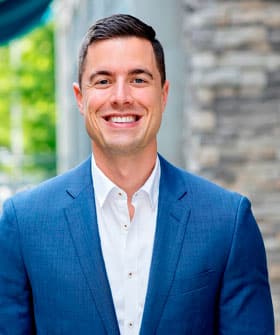
Second Opinion: Before getting into health tech, you were a drummer in Nashville. Does that musical background influence how you lead a massive healthcare company today?
Ric Sinclair: Absolutely. In business, we often use sports metaphors about discipline and work ethic, but we overlook the competitive intensity of creatives. As a drummer, you are setting the foundational layer and the vibe for the band. You aren't trying to take the microphone or look for a solo.
It embodies what it means to be a servant leader: your entire job is figuring out how to make everyone else around you sound better and perform better. Furthermore, as a drummer, you learn that it is much harder to keep things really simple than it is complicated. And when you mess up, when you drop a stick or fall off beat, everyone notices it immediately. That philosophy of building a quiet, reliable foundation translates perfectly to building the infrastructure layer healthcare desperately needs.
Second Opinion: There is a massive amount of friction and waste in healthcare right now. Is this fundamentally a data or technology problem?
Ric Sinclair:No. I don't think healthcare has a data problem or a technology problem; it has a coordination problem and an infrastructure problem. The data is already there. Right now, there is over a trillion dollars of wasted spending on administrative overhead and bureaucracy in this country.
It might be a controversial statement, but I genuinely believe there are best intentions on all sides of this network—across patients, providers, health plans, employers, and pharma. These are people who are moms and dads in their communities who all want to bring healthcare inefficiencies and costs down. We don't have bad people; there is just no end-to-end infrastructure company that exists in healthcare today.
To fix this, we have to build a foundational platform layer. If we do that, we can look at a $1,000 claim and actually reduce the cost it takes to get that claim paid by 70% to 80%.
Second Opinion: Everyone assumes AI will immediately cut administrative costs and headcount. You have a very different "hot take" on this. Why?
Ric Sinclair:If we just layer AI onto our current, siloed system, costs could actually go up before they come down. Because the first wave of clinical AI tools is provider-facing scribes, we may see an initial increase in net billing as these systems capture clinical complexities more accurately. When the unit cost for a provider to resubmit a claim drops to practically zero, friction naturally increases.
However, I am a genuine optimist that AI will ultimately be a massivejob creatorin healthcare administration. By using AI to eliminate mundane, procedural tasks, we will be expanding roles and upskilling our people into higher-level, subject-matter expert positions. I compare it to the iPhone 25 years ago. Back then, it was controversial to think people would use a mobile phone for professional emails. Today, it’s absurd to think otherwise. AI won't replace us; it will become a natural work companion and thought partner that gives employees broader autonomy to solve higher-level problems.
Second Opinion: When you became CEO of Cotiviti, you actually received pictures of Darth Vader from industry insiders. How are you navigating that intense payer-provider friction?
Ric Sinclair:When I joined, close friends congratulated me, but others literally sent me photos of Darth Vader and asked why I was joining the "dark side". Payer and provider abrasion is at an all-time high. We can either keep complaining and throwing shade at each other, or we can step in and fix it.
We are actively hosting "whiteboard sessions," bringing leaders from payers and providers into the same room to map out the next era of healthcare. My goal is to take our thousands of clinical experts, AI engineers, and data scientists and build that foundational coordination layer. We operate on four core values: be people-obsessed, build better, be deeply curious, and make it count. If we do that, in three years, I believe we will have a healthcare system that is fairer, more transparent, and has a meaningful amount of waste permanently taken out of it.