

Healthcare navigation wasn’t wrong. It was early.

Castlight Health sponsored this edition to celebrate its return to the Castlight name. After operating under Apree Health for a period, the company is leaning back into the brand that pioneered healthcare navigation while leading the next generation of what navigation can deliver. Why? Because navigation is back, baby.
Four years ago, while working on the investment team at the venture capital firm OMERS Ventures, I wrote about the rise of healthcare navigation companies — vendors designed to help employees find doctors, understand their benefits, and make sense of an opaque system that even experts struggle with. The piece garnered a big reaction from the health-tech community (mostly positive, but some pushback). My co-author for the piece was my former colleague Michael Yang, a veteran healthcare-technology investor and former Accolade board member.
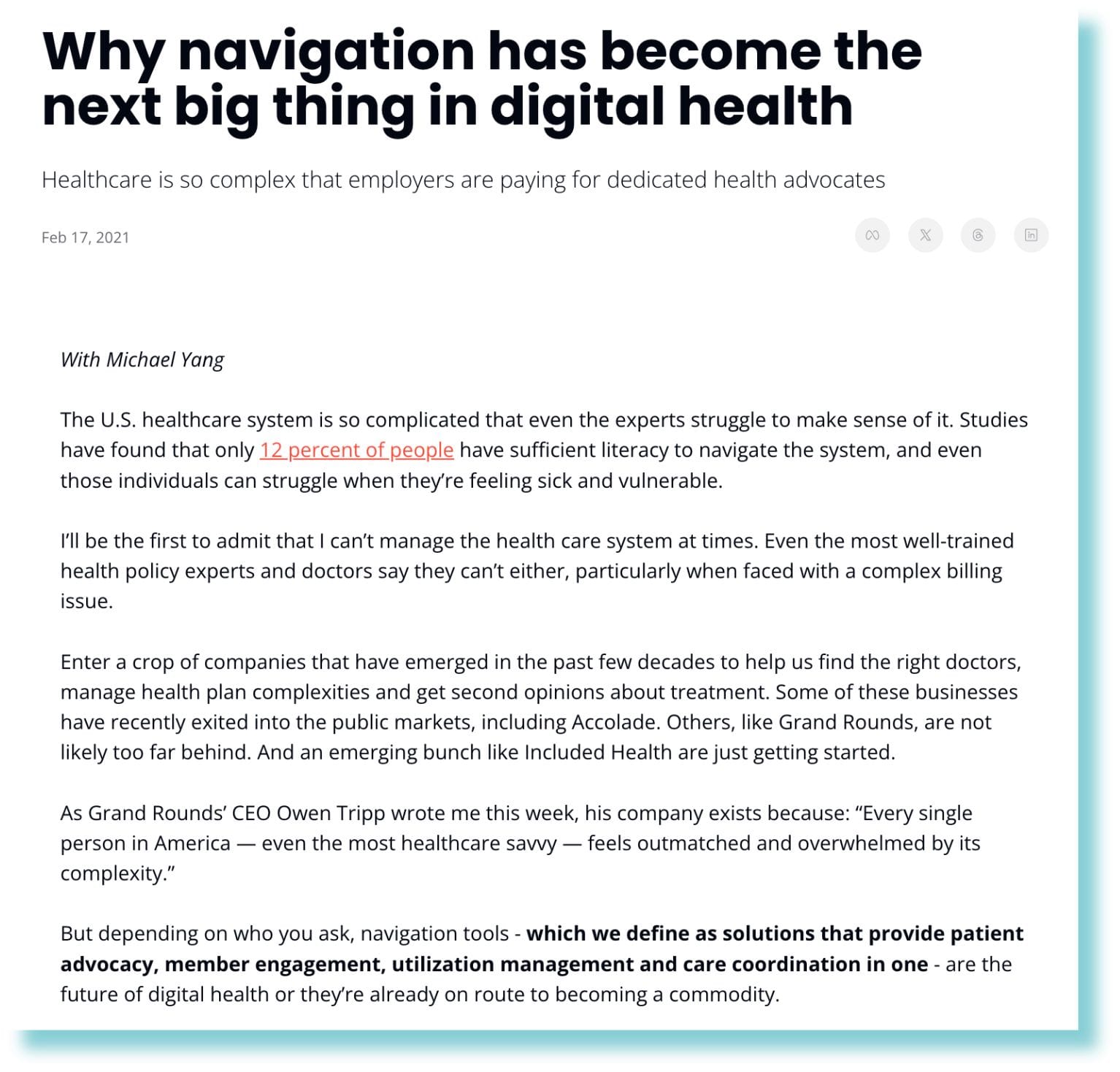
At the time, as we explained in the piece, navigation was largely defined by human advocates. Accolade, which was publicly traded and one of the category’s early winners, built its reputation on trained, empathetic individuals who helped employees find in-network providers, resolve billing issues, and coordinate care. These were teams of trained guides, often working out of call centers, helping employees navigate a fragmented system.
The value proposition for these players - for the purpose of the piece, let's call them “Gen 1 navigators” - was straightforward: healthcare is confusing, and people need help making sense of it. Navigators offered a so-called “front door” for healthcare for members that chose to use these services by logging into the app or calling the 1-800 number, and occasionally scored a win by referring a patient to a lower cost option. Imagine a situation where a doctor recommended an orthopedist for a patient’s back pain as the next step. Assuming the patient wanted a second opinion or needed help with a referral to an in-network specialist, a company in the navigation space might intervene and recommend a consultation with a more affordable physical therapist instead. That’s essentially Navigation 1.0.
“As an industry, we have been trying to solve this problem for multiple decades,” said Castlight CEO Jon Porter. “That’s essentially how to transition someone from point A to point B in a way that feels great for them and optimizes healthcare overall.”
That transition piece is more challenging than it might seem, according to Porter. And that’s what our original thesis got wrong. In the ensuing years since we wrote it, some vendors got acquired, some shut down, and several got absorbed into broader platforms. That includes TPAs like Quantum Health, primary care models like Included Health, Centers of Excellence programs (Accolade after the Transcarent acquisition), and integrated care platforms that focus on areas like advanced primary care, like Castlight/ Vera Whole Health. As we’ll explore throughout this piece, that shift has been a necessary one, and it aligns much more with customers’ expectations. Standalone navigation is a tricky value proposition, arguably outside of niche areas like specialty pharmacy, which is where it makes sense to embed it into a broader set of solutions that are driving towards delivering higher quality, lower cost care.
By expanding into new areas, like primary care, navigation also benefits by reaching the patient upstream of the moment where they’ve already received a recommendation from a doctor they trust or gone to the emergency room. “Navigation 1.0 was about changing the decision for the consumer. A navigation company would try to insert themselves between the patient and their provider, and influence the decision,” Porter continued. “Navigation 2.0 is about having the member come to us to help the member make the optimal decision in the first place. So imagine a scenario where a primary care doctor sees that back pain… we will make the patient and their provider aware that there’s this covered benefit called Hinge Health that’s virtual, offered by their employer, and super convenient.”
As we move into this new era for navigation, there’s also a renewed interest from venture capital firms in navigation after a five-year or so hiatus. Investors now perceive an opportunity for navigation companies that are deeply personalized, AI native, consumer-centric, and people light (a.k.a not a glorified call center). That’s the thesis that drew Sam Toole, a partner at New York-based firm Primary Ventures, to make a bet in a stealth company called Tokaido Health in the pharmacy navigation space.
“What’s old is new again,” he said.
So what happened? Why wasn’t Gen 1 navigation the “next big thing”?
Brad Nations, an independent advisor working with Castlight, thinks of the first generation of navigation players as being built for a time when it was enough to sell employers on value on investment or VOI. Could these vendors provide a better experience for a member in a competitive talent market? Now, it’s all about return on investment or ROI. Employers want to know how they can partner to bring down the top five drivers of cost (musculoskeletal, cancer, behavioral health, GI, diabetes, and pregnancy/ postpartum are typically on the list for most). A single medical claim in one of these areas can easily cost millions of dollars for an employer and their health plan.
The challenge with Gen 1? Many of the early navigators could reliably deliver VOI for the employer and their members. But ROI was a harder case to make, especially if they weren’t top of mind in a moment of need for the member, where an intervention could make a big difference. Part of the challenge was related to consumer experience (too many native apps). Another issue was structural. Early navigation companies were trying to improve the healthcare experience while operating outside the core infrastructure — namely, the health plan itself.
“The early disruptors were able to sell on the idea that healthcare is complicated and your health plan is not doing a good job helping simplify the experience,” Michael Perlmutter, senior director at the consulting firm WTW, told me. “But what they found was the experience is still very fragmented when carving out from the health plan.” And in fairness to these companies, the larger health plans weren’t quite sure whether to embrace navigation or compete with it. Nowadays, as Porter told me, many health plans, including smaller, regional plans and modern TPAs, have seen the light and know where their strengths and weaknesses lie. Gen 1 navigators also didn’t always get access to the critical data about denied claims or the status of a claim, so patients ended up having to go to the insurer nonetheless. Again, that’s increasingly starting to change – and payers are under much more pressure to share this information.
The economics of the model were also difficult to sustain for the first generation. Many navigation vendors relied on staffing-heavy approaches, employing clinicians, care coordinators, and customer support teams to deliver personalized guidance. “The early models required higher staffing levels, with more clinical expertise and more technology and data management functions,” Perlmutter said. “That resulted in higher administrative costs, and the investment in staffing did not always translate into meaningful savings.”
Another problem was the lack of targeting. Healthcare spending is highly concentrated among a small subset of patients, but early navigation models were designed to support everyone equally. 3% to 5% of employees routinely drive 50% of costs, but the early engagement models treated everyone equally.
That dynamic is beginning to change, as newer platforms use analytics to identify higher-risk members earlier and intervene more selectively. As Nations explained, the key is really to focus on those top drivers of spend and help members engage in lower-cost, higher-quality forms of care. Katie Christiansen, who works in marketing at Castlight, also pointed out that the right messages for the right audience also matter. An apparently healthy individual without claims data for a few years, because they avoid the doctor, could be well. But also could be undiagnosed and high-risk, making a primary care visit a crucially important next step. A truly well person might need one to two touchpoints a year with a health coach or care guide, she said.
That step into services might involve a digital health vendor, like a Hinge Health or Sword Health, but it might also mean the navigator helps a patient proactively get an appointment at a brick-and-mortar clinic. Reaching these members at the right moment is everything - and that could mean creating a new app, but it might also mean a text messaging service or a chat interface built on top of Gemini, Anthropic, or OpenAI. Employers and navigation companies view interfaces as needing to evolve to meet the members where they are – or at least, as much as possible in light of challenges related to privacy and compliance.
The fragmentation problem
One of navigation’s central promises involved simplification. But in practice, navigation itself became fragmented.
“An employer would have a general navigation vendor, but then they’d also have an oncology navigator or a behavioral health navigator,” Ellen Kelsay, president and CEO of the Business Group on Health, said. “So even within navigation, you had micro niche needs.”
Some of these specialized vendors focused on specific clinical areas, like cancer or behavioral health, where care decisions are particularly complex and costly. Others helped employers steer employees toward higher-quality providers or Centers of Excellence programs that favored certain providers over others, based on factors like cost and outcomes. There was a clear rationale for specialization.
“The good news is there is a need there,” Kelsay said. “People do need comprehensive support.”
But the proliferation of niche vendors also created operational challenges.
“The challenge is that you have these micro navigators,” she said. “What, are you going to have seven different micro navigators? That’s not tenable at scale.”
This dynamic mirrored what happened across digital health more broadly. Employers adopted “point solutions” to address specific gaps, like diabetes or behavioral health, only to discover that stitching them together created new complexity. It also put pressure on shrinking benefit teams to manage vendor procurement, renewals, paperwork, and more. Moreover, some of the highest cost patients have multiple comorbidities and might need access to a behavioral health solution, a hypertension solution, a pregnancy solution and more – and that meant navigating multiple vendors. Navigation companies themselves weren’t immune to this trend. Some evolved into care delivery organizations. Others became integrators of third-party services. Many pursued both strategies simultaneously.
Victor LeClere, head of commercial at Castlight Health, believes the role of navigation itself is expanding to solve the fragmentation problem.
“In my view, navigation is evolving to own clinical prioritization and coordinate execution across a fragmented ecosystem,” he said.
That shift reflects a broader change in how employers think about healthcare costs. The focus is less on negotiating prices and more on influencing utilization — determining whether employees receive appropriate care in the first place, and where.
“Our job is to intervene before someone enters a high-cost network,” LeClere added. “That could be through onsite care, near-site care, or a point solution.”
Navigation is moving deeper into the clinical layer
Early models focused primarily on answering questions — helping employees find providers, understand coverage, or resolve billing issues. These vendors also assumed the member knew best and would answer questions directly. So if someone typed in a search for an orthopedist because of back pain, it surfaced a provider in-network. Newer platforms aim to influence clinical decisions more directly, and they will have the capacity to go a step further for patients in solving billing challenges, proactively making appointments, and so on. Or refer to a primary care doctor that might suggest a lower-cost option.
“When the original article came out, highly human call center models were at the forefront,” LeClere said. “The first batch of companies were very focused on the search experience and access. Now we’re building a layer focused on clinical decision-making and prioritization.”
That shift requires deeper integration with clinical programs, providers, and data systems. It also opens the door for navigation companies to play a more central role in managing healthcare spending. As navigation platforms integrate with centers of excellence, specialty pharmacy programs, and primary care, some may eventually also move toward risk-based models. As the Peterson Health Technology Institute (PHTI) explored in a recent report, outcomes or performance-based contracting is all the rage amongst plan sponsors, especially jumbo employers - but there’s massive hurdles related to how to measure success. That creates a big opportunity for the forward-thinking navigation vendors and the new startup entrants.
“Employers have exhausted many of their traditional options for managing costs,” Perlmutter said. “The goal now is to better utilize the programs they’ve already purchased that add value but aren’t being fully utilized.”
Employers still want navigation — but may want it embedded elsewhere
Despite the challenges, navigation remains widely viewed as necessary — largely because the underlying healthcare system remains difficult to navigate.
“Because we have made things so complicated, and because not all care is quality care, I believe we do still need navigation,” Kelsay said.
At the same time, employers increasingly expect navigation to be embedded into other parts of the healthcare system. “Ideally it’s embedded in primary care, Centers of Excellence, or health plans,” she said. As we have previously asserted in Second Opinion, navigation in primary care is particularly impactful in the value-based care realm. The broader takeaway is clear: navigation may be most valuable not as a standalone product, but as a coordination layer across an increasingly complex ecosystem.
Artificial intelligence, or AI, is beginning to reshape navigation as well.
AI tools could automate routine tasks like answering benefits questions, triaging symptoms, and recommending providers — reducing reliance on large human support teams that bring down efficiency and impact a company’s unit economics. Humans will not be replaced overnight. More likely, the AI provides a massive assist, particularly if the LLM has its hooks in other forms of data that are important when it comes to fully understanding the members’ needs (their claims history, medical record, schedule, demographic information, and more). The AI world really changes the game here, as the integration can occur at the level of agent to agent. Navigator agents will converse with point solution agents, exchanging information autonomously and passing data seamlessly.
“People historically haven’t shopped for healthcare,” Perlmutter said. “But as AI makes it easier to ask questions and get recommendations, people may be more receptive to employer-sponsored programs.”
Several of the experts I spoke to said they were excited about leveraging AI to ensure navigation players can better identify emerging health needs and proactively guide individuals toward appropriate care. But at the same time, one challenge will be that employees are increasingly accessing care outside traditional employer-sponsored benefits entirely — through direct-to-consumer services.
“People are going around benefits,” LeClere acknowledged.
That trend could create both risks and opportunities for navigation vendors. The companies that succeed may be those that can integrate employer-sponsored benefits with the broader ecosystem of healthcare services, apps, and tools employees already use. There might also be moves into helping employees tap their HSA dollars for popular wellness and longevity services. That’s something Castlight is working on, after surveying thousands of people and finding that 1 in 5 rely exclusively on consumer health solutions, according to its CEO. In December, as one example, the company started working with the weight loss app Noom. The settlement between Express Scripts and the FTC is also important here – cash pay can count towards a member’s deductible. Right now, cash pay occurs outside of benefits plans, and there’s no record of it that goes back to claims feeds. Navigators in the future could entirely change that.
Navigation is becoming infrastructure
What’s clear in 2026 is that navigation is no longer just about helping employees find doctors or answer basic questions about their benefits.
It’s becoming part of the infrastructure that determines where care happens, how it’s delivered, and how much it costs. If the ecosystem moves more to performance-based contracting models, its true value could be in identifying the members that need care at the moment they need it. Imagine a Sword Health or Lantern only gets paid on the basis of an outcome. These companies will need to know exactly which patients they can impact within the population by improving the quality of their care and bringing down costs. That’s a potential role for a navigation vendor, provided the company builds out a web of partnerships and integrations – with the vendor, with the health plan, with the brick and mortar universe, and more.
So we were half correct in the original thesis. Navigation did get more important as healthcare got more complicated and costs skyrocketed. But the first generation had its challenges, namely in the lack of integration with the traditional ecosystem, whether that be the pharmacy benefits managers or health plans. But I do now believe that navigation is ready for its next act. And the second generation will look very different from what we’ve seen before.
AFTERWORD FROM MICHAEL YANG

The first-generation navigation companies that came about in the mid 2000s had more of a BPO (business process outsourcing) DNA. KPIs were call center business-like, such as time to answer and the number of inquiries resolved on the first call. The role of technology was systems integration and IT-centric. Early pricing models were double-digit PMPM because navigation vendors were effective at garnering high utilization rates for high-cost claimants.
But things would change. With more competition, $20+ PMPMs had to come down. PEPM usurped PMPM. So what did you do? At first, you iterated on your staffing model with differentiated costing levels. Then you bifurcated tasks to the right cost labor. Then you gave your laborers better technology so they could do their work more efficiently. Eventually, you automated certain tasks and enabled the end user to self-serve. This roadmap was well known, but still took effort to realize.
However, as navigation solutions showed value, their customers asked them to do more. Employers realized that navigation could be applied more horizontally, across more administrative and clinical processes, as well as more vertically, deeper within multiple specific clinical realms. This expansion of TAM was great on the one hand, but challenged the cost to serve on the other hand. It's why profitability has long evaded this industry.
Perhaps with the new LLM-first world and much of the tech burden being born by the AI labs, a new generation of navigation companies can just focus on the right layers at the AI top to deliver the same value and more. In my opinion, that has to be the outcome because employers have continued to push PEPM pricing down, navigation is now an established check-the-box benefit for covered lives, and the category is commoditized with economics no longer able to support meaningful innovation.
I can still remember hearing so many calls where an Accolade health assistant was so effective at changing a Comcast employee's life around that you truly felt you were observing something spiritual. Navigation may have lost its way in the interim in its progression to simultaneously go broader and deeper, while improving unit economics. Maybe now, we will get a new Cambrian explosion of navigators that can truly do it all. One can hope!
Upcoming Sessions
Live conversations with the people shaping healthcare.

Is It Finally the Moment for Alternative Plan Design?
Register Here Employers are under growing pressure to control healthcare costs while improving access, outcomes, and the member experience. That has renewed

Type 2 Diabetes & Cardiometabolic Care: Wearables, AI & GLP-1s
Register Here The rise of wearables, GLP-1s, and AI is reshaping treatment for Type 2 diabetes, weight loss, and metabolic disease.

Verifying AI in Medicine: Is Healthcare AI Actually Ready for Deployment?
Is AI ready for real-world clinical care? Dr. Zak Kohane and Protege’s Engy Ziedan debate what it takes to safely trust AI in diagnosis and treatment, from benchmark performance and clinical evidence to whether we’re holding AI to a higher standard than humans.

Why Are Hospitals Hiring Chief AI Officers?
As AI moves from pilots into day-to-day healthcare operations, health systems are having to decide who should actually own the


Where are AI Agents Actually Working in Healthcare, and Why?
While the healthcare industry remains locked in a high-level debate over the theoretical potential of artificial intelligence, a select group of

Top Employers Share What Healthcare Startups Need to Know in 2026
As enterprise health purchasers face volatile medical cost trends and tightening operational margins, the standard vendor pitch of "improved clinical efficiency&

Peptide Therapy: Where Do We Go From Here?
Watch the full webinar Peptide therapies have moved from niche biohacking circles into mainstream medicine, reshaping conversations around weight management, metabolic health,

Not everyone can access the top 1% of physicians. Will AI change that?
Historically, top-tier medical expertise was limited by wealth and geography. As AI reshapes healthcare delivery, a vital question emerges: can it democratize intelligence to give everyone access to the caliber of care typically reserved for the top 1%?

Privacy AI and the Future of HIPAA
Watch the Full Webinar As AI reshapes healthcare and more patient data flows beyond traditional clinical settings, the rules governing privacy, access,