

Healthcare AI Companies are Building for the Wrong Buyers
Mark Sendak is the CEO of a healthcare AI company serving community hospitals. He is a founder of Health AI Partnership and formerly worked at the Duke Institute for Health Innovation for over a decade.
The leader of a community hospital system in Kentucky recently told me, “I’ve exhausted our resources trying to keep up with AI”. Another leader in South Dakota wasn’t sold by the marketing of a well-known AI vendor. “They’re not building for us,” he explained while pointing to press releases that touted multi-million dollar contracts with prestigious academic medical centers. “They don’t understand we serve Native American populations in four of the five poorest counties in the United States.”
6000 hospitals in America need AI and other technology solutions. AI vendors are building for the 400 hospitals affiliated with academic medical centers, while community health systems’ needs are going ignored by startups. I spent the last decade of my career helping build an innovation group at one of these large academic medical centers – and I can tell you that this is the most significant distribution failure in healthcare.
Reserve Your Spot for Upcoming Webinars!
Academic medical centers and community hospital systems both deliver care in hospital and clinic settings, but have a few major differences. Academic medical centers typically house a medical school and serve as the primary training site for medical students, residents, and fellows. They also have large research programs with significant external grant funding. Meanwhile, community hospitals do not typically house medical schools and have limited externally funded research.
When I started Vega Health last year, I knew from the start that we would not be focusing on the big-name logos. We knew that community health systems still had needs that other startups were treating as an afterthought. Meanwhile, they represent a whopping 93% of American hospitals.
The vendor ecosystem continues to act as if the most advanced health systems and academic medical centers should be their core buying segment (or only buying segment). The reasons for it do make sense. These are big, prestigious systems with hospitals that top national rankings, and technology companies can ink contracts for many millions of dollars in a single year. These contracts also tend to be sticky, meaning they don’t churn, and it’s perceived as easier to raise capital off of them.
But there are also massive challenges. As a group of health system executives and Cadence chief medical officer Dr. Eve Cunningham recently discussed on a Second Opinion webinar alongside executives from the University of Chicago and Corewell Health, academic medical centers tend to be risk-averse, and getting a contract requires months (if not years) of work with legal, compliance, IT - not to mention aligning internal stakeholders.
Other startups may think that locking in the big logos of prestigious academic medical centers translates to rapid sales versus the long tail of community health systems. My experience suggests otherwise. For more than a decade at the Duke Institute for Health Innovation, I watched leading researchers and innovators at places like Duke, Michigan Medicine, and Kaiser Permanente develop best-in-class AI solutions that failed to scale broadly to community hospital systems.
`Upcoming Sessions
Live conversations with the people shaping healthcare.

Verifying AI in Medicine: Is Healthcare AI Actually Ready for Deployment?
Is AI ready for real-world clinical care? Dr. Zak Kohane and Protege’s Engy Ziedan debate what it takes to safely trust AI in diagnosis and treatment, from benchmark performance and clinical evidence to whether we’re holding AI to a higher standard than humans.


Where are AI Agents Actually Working in Healthcare, and Why?
While the healthcare industry remains locked in a high-level debate over the theoretical potential of artificial intelligence, a select group of

Top Employers Share What Healthcare Startups Need to Know in 2026
As enterprise health purchasers face volatile medical cost trends and tightening operational margins, the standard vendor pitch of "improved clinical efficiency&

Peptide Therapy: Where Do We Go From Here?
Watch the full webinar Peptide therapies have moved from niche biohacking circles into mainstream medicine, reshaping conversations around weight management, metabolic health,

Not everyone can access the top 1% of physicians. Will AI change that?
Historically, top-tier medical expertise was limited by wealth and geography. As AI reshapes healthcare delivery, a vital question emerges: can it democratize intelligence to give everyone access to the caliber of care typically reserved for the top 1%?

Privacy AI and the Future of HIPAA
Watch the Full Webinar As AI reshapes healthcare and more patient data flows beyond traditional clinical settings, the rules governing privacy, access,

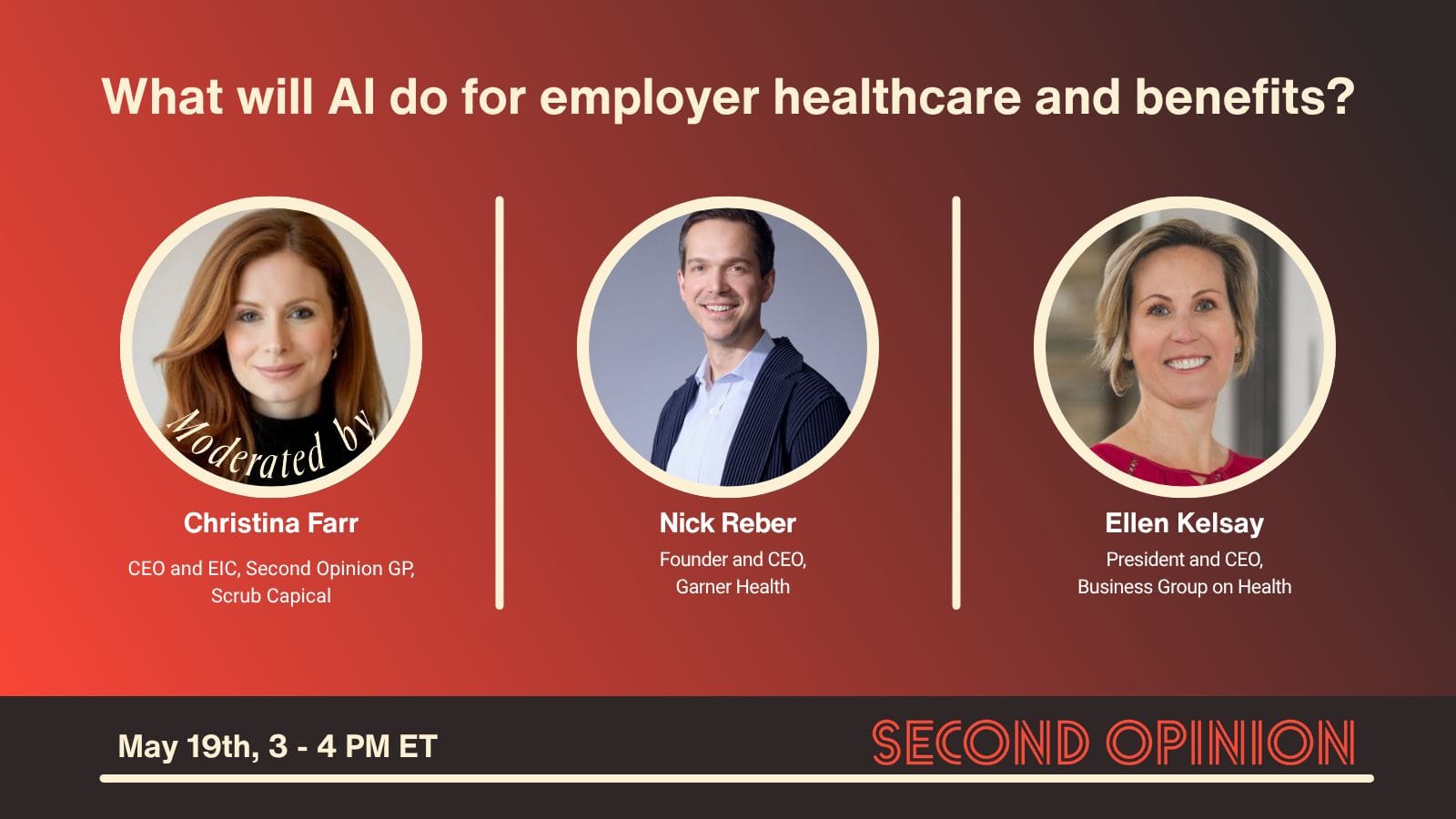
What will AI do for employer healthcare and benefits?
Employer healthcare may be one of the most practical — and overlooked — proving grounds for AI.

Hospitals as the new go-to-market, lessons from the trenches
Watch the Full Webinar Health systems are entering a new frontier, one where innovation isn’t optional, and meaningful change requires creativity,

Breaking Point: How Healthcare Costs Are Reshaping Employer Strategies
In this Second Opinion webinar, we’ll bring together economists, benefits leaders, and innovators to unpack what’s driving today’s cost crisis, why traditional containment strategies are falling short, and which approaches are beginning to break through.