

Health systems don’t have time for a bunch of different AI products


Ruth here again. This week, I’m paying attention to a white paper that says health systems have a hard time managing a glut of AI products and are wedded to their electronic health records’ timelines to adopt artificial intelligence.
The paper was compiled from 1:1 interviews with more than 60 executives at medium and large health systems, including CIOs, Chief AI Officers, CMIOs, and other senior IT leadership by Qventus, an AI platform for hospital operations.
The vast majority of respondents (88%) said that in 2025, they implemented AI governance frameworks and began implementing AI tools across their organizations. A year ago, only half of the respondents reported organization-wide rollouts of AI products.
Here are the major points of the survey that stick out to me:
- Three-quarters of respondents said dependence on EHR timelines is impeding their ability to adopt AI.
- More than half said managing multiple AI vendors is straining their IT resources.
- Over 70% said they would prefer to operate with one comprehensive AI partner who manages multiple use cases, but only 11% are currently taking that approach.
Another barrier: measuring the return on investment for AI products.
Slightly less than half of respondents said they are deploying AI across multiple use cases, but only 4% have achieved scaled AI implementation with measurable outcomes.
Part of the problem is that there isn’t necessarily agreement about what should be measured. Some organizations look at whether products are leading to revenue generation, cost savings, or improved outcomes for patients. But sometimes the ROI is less tangible—like improved morale for doctors. For that reason, 39% of respondents don’t have a clear process for benchmarking AI performance or ROI.
Headwinds/tailwinds? The report says that the 2025 One Big Beautiful Bill is expected to lead to $1 trillion in federal spending cuts that will impact organizations that receive reimbursement from Medicaid and Affordable Care Act programs and put pressure on hospital margins.
That financial pressure, combined with labor shortages, may actually stoke AI / NIV, as health systems move to make their operations more efficient.
Key insight: Dr. Joseph Sanford, chief clinical informatics officer at the University of Arkansas for Medical Services, who was one of the respondents in the survey,v said he thinks there’s a real opportunity for creative disruption.
“A lot of really cool solutions will come out of those who are working with the FQHCs of the world or working with non-major academic medical centers, right? [Those who aren’t fully and inevitably committed to whoever their EHR is,” he told Second Opinion.
And now onto the news of the week, as compiled by Annalise.
Reserve Your Spot for Upcoming Webinars!
NEWS
Digital health startups raked in $4 billion in Q1
Megadeals are driving investments into AI startups, which have raised a combined $4 billion in the first quarter of 2026. This is both a larger sum compared to the $3 billion of 2025 and spread over fewer deals. The average deal was $36.7 million, the highest value since 2021.
AI Scribes are increasing health care costs, and there is no clear solution
We often hear that AI scribes are making healthcare more efficient and helping providers get paid better. Turns out, not so much: not only do the efficiency gains appear modest, but costs are going up, according to insurers and providers, and there’s no clear solution in sight.
UnitedHealth is betting $ 3 billion on AI
Speaking of AI costs, UnitedHealth is investing $3 billion in a big AI push. This could have a big impact on patients’ lives, if AI is tasked with making important coverage decisions. The insurer has already been under fire for its use of AI to deny claims.
The FDA rejected a push to deregulate some AI
Despite the Trump administration’s promise to remove barriers for health AI companies, the FDA denied Harrison.ai’s proposal to exempt some AI devices from premarket reviews. The company, which makes AI tools that support radiologists in evaluating medical imaging, filed the petition last year, and received a complete and detailed refusal, despite the fact that the current head of the FDA’s Digital Health Center of Excellence used to work for a Harrison.ai subsidiary.
A CONTROVERSIAL TAKE
As the healthcare system turns to AI to make up for physician shortages, Glenn Steele Jr., the former CEO of Geisinger Health System, wrote in an op-ed that the US health system has the opportunity for radical labor replacement through AI. Technology, he says, could replace a large amount of positions — administrative, operational — that are currently burdening the system with unnecessary costs.
DEALS & LAUNCHES
All deals are AI now, so Rock Health is retiring its AI deal tracker.
Catalyst MedTech, a nuclear medicine and molecular imaging solutions company acquired X3D, a leading manufacturer for medical equipment companies.
Anthropic acquired Coefficient Bio, a company founded by former Genentech researchers less than a year ago, to build out Claude’s capabilities as an infrastructure for drug discovery. The all-stock transaction is valued at $400 million.
Merit Medical expanded its oncology portfolio by acquiring Viewpoint Medical, the company producing a steerable needle technology for accessing difficult-to-reach tumors. The transaction value is estimated at $140 million.
Blackstone-backed AGS Health is eyeing a $500 million IPO in India, with the plan of capitalizing over the medical outsourcing market.
AI-native brokerage platform Gyde acquired Avid Health, a top-rated Medicare agency. This is Gyde’s first announced partnership after its recent public launch with a $60 million backing from Lightspeed.
Health insurance infrastructure company Yuzu Health closed a $35 million Series A round led by General Catalyst and Chemistry.
HeyDonto, a dental AI company building a dental-medical interoperability platform, raised $20 million in a Seed round at a $200 million valuation. The round was funded by eight private investors, including practicing dentists.
Luminai, an AI company to streamline health system operations, announced its partnership with the Cleveland Clinic and $60 million in funding.
Menopause provider Alloy is expanding its weight management offering with a $99/month program, plus at least $70 a month for medications.
Waystar is launching the first AI tool to address post-payment adjustments, known as “silent denials,” which take an estimated $40 billion from providers.
LIFERS THIS WEEK
And this week on Lifers, Christina Farr sits down with the Access TeleCare founder and chief strategy officer, Dr. Chris Gallagher, as well as TeleCare’s chief of maternal-fetal medicine, Dr. Blake Porter, to talk about a new area of growth for telehealth, following its pandemic-era surge. Telehealth is now bringing subspecialty expertise to places that don’t often have access to specialized care.
Want to support Second Opinion?
- 🌟 Leave a review for the Second Opinion Podcast
- 📧 Share this email with other friends in the healthcare space!
- 💵 Become a paid subscriber!
- 📢 Become a sponsor
Upcoming Sessions
Live conversations with the people shaping healthcare.

Is It Finally the Moment for Alternative Plan Design?
Register Here Employers are under growing pressure to control healthcare costs while improving access, outcomes, and the member experience. That has renewed

Type 2 Diabetes & Cardiometabolic Care: Wearables, AI & GLP-1s
Register Here The rise of wearables, GLP-1s, and AI is reshaping treatment for Type 2 diabetes, weight loss, and metabolic disease.

Verifying AI in Medicine: Is Healthcare AI Actually Ready for Deployment?
Is AI ready for real-world clinical care? Dr. Zak Kohane and Protege’s Engy Ziedan debate what it takes to safely trust AI in diagnosis and treatment, from benchmark performance and clinical evidence to whether we’re holding AI to a higher standard than humans.

Why Are Hospitals Hiring Chief AI Officers?
As AI moves from pilots into day-to-day healthcare operations, health systems are having to decide who should actually own the


Where are AI Agents Actually Working in Healthcare, and Why?
While the healthcare industry remains locked in a high-level debate over the theoretical potential of artificial intelligence, a select group of

Top Employers Share What Healthcare Startups Need to Know in 2026
As enterprise health purchasers face volatile medical cost trends and tightening operational margins, the standard vendor pitch of "improved clinical efficiency&

Peptide Therapy: Where Do We Go From Here?
Watch the full webinar Peptide therapies have moved from niche biohacking circles into mainstream medicine, reshaping conversations around weight management, metabolic health,

Not everyone can access the top 1% of physicians. Will AI change that?
Historically, top-tier medical expertise was limited by wealth and geography. As AI reshapes healthcare delivery, a vital question emerges: can it democratize intelligence to give everyone access to the caliber of care typically reserved for the top 1%?

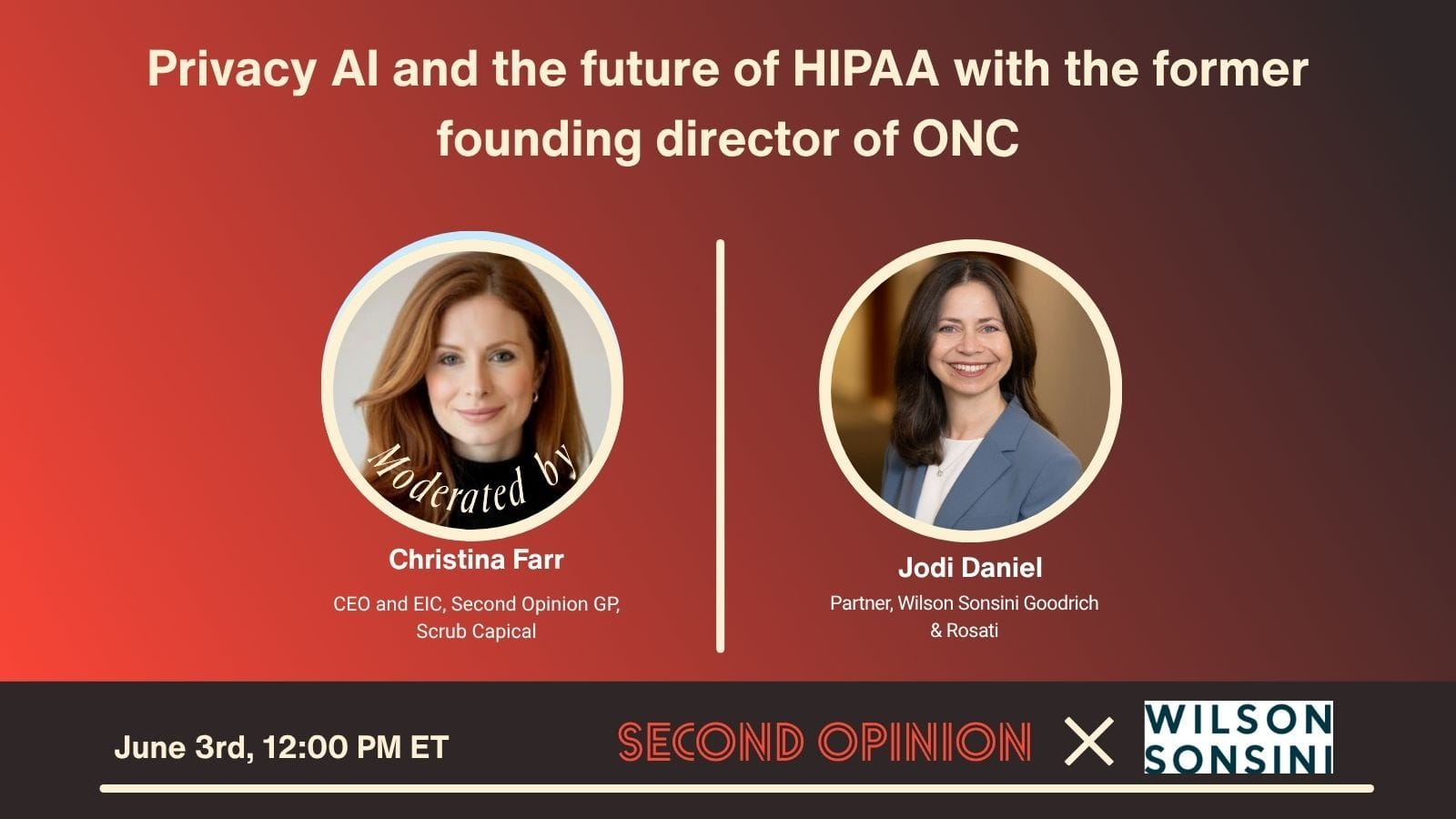
Privacy AI and the Future of HIPAA
Watch the Full Webinar As AI reshapes healthcare and more patient data flows beyond traditional clinical settings, the rules governing privacy, access,